The Idea is Simple#
Take a solar panel or two, mount them on your balcony, plug a micro-inverter into a wall socket, and start producing your own electricity. No electrician, no permits, no roof access needed. In many EU countries, this is not only legal — it’s encouraged and subsidized.
The concept is called balcony solar (or plug-in solar, Balkonkraftwerk in German). It’s designed for renters, apartment dwellers, and anyone who can’t install a full rooftop system. The typical setup is 1-2 panels (600-800W) with a micro-inverter that feeds directly into your home circuit.
It’s one of the fastest-growing segments in European solar. And Greece — one of the sunniest countries in Europe — is somehow still figuring out if it’s allowed.
What the EU Says#
The European Union has been actively pushing solar adoption on buildings. The revised Energy Performance of Buildings Directive (EPBD) requires solar installations on new buildings, entering into force gradually from 2026. The directive explicitly covers facades, balconies, terraces, and similar structures — not just rooftops.
Multiple EU member states have already implemented clear frameworks:
| Country | Status | Details |
|---|---|---|
| Germany | Fully legal | Over 1 million registered systems. Up to 2kW / 800VA. Online registration only. |
| Austria | Legal | Up to 800W, simplified registration |
| Netherlands | Legal | Up to 600W, plug-and-play allowed |
| Belgium | Legal (2025) | Synergrid safety certification required |
| Italy | Legal | Various regional incentives |
| Bulgaria | Fully legal | Legislated and approved |
The trend is clear: the EU wants citizens to generate their own electricity with minimal bureaucracy. Germany alone added 435,000 balcony PV systems in 2024.
Here’s the EcoFlow app’s grid-tied output configuration — it lists every country where balcony solar is officially regulated, with the regulatory power limit. Notice anything missing?
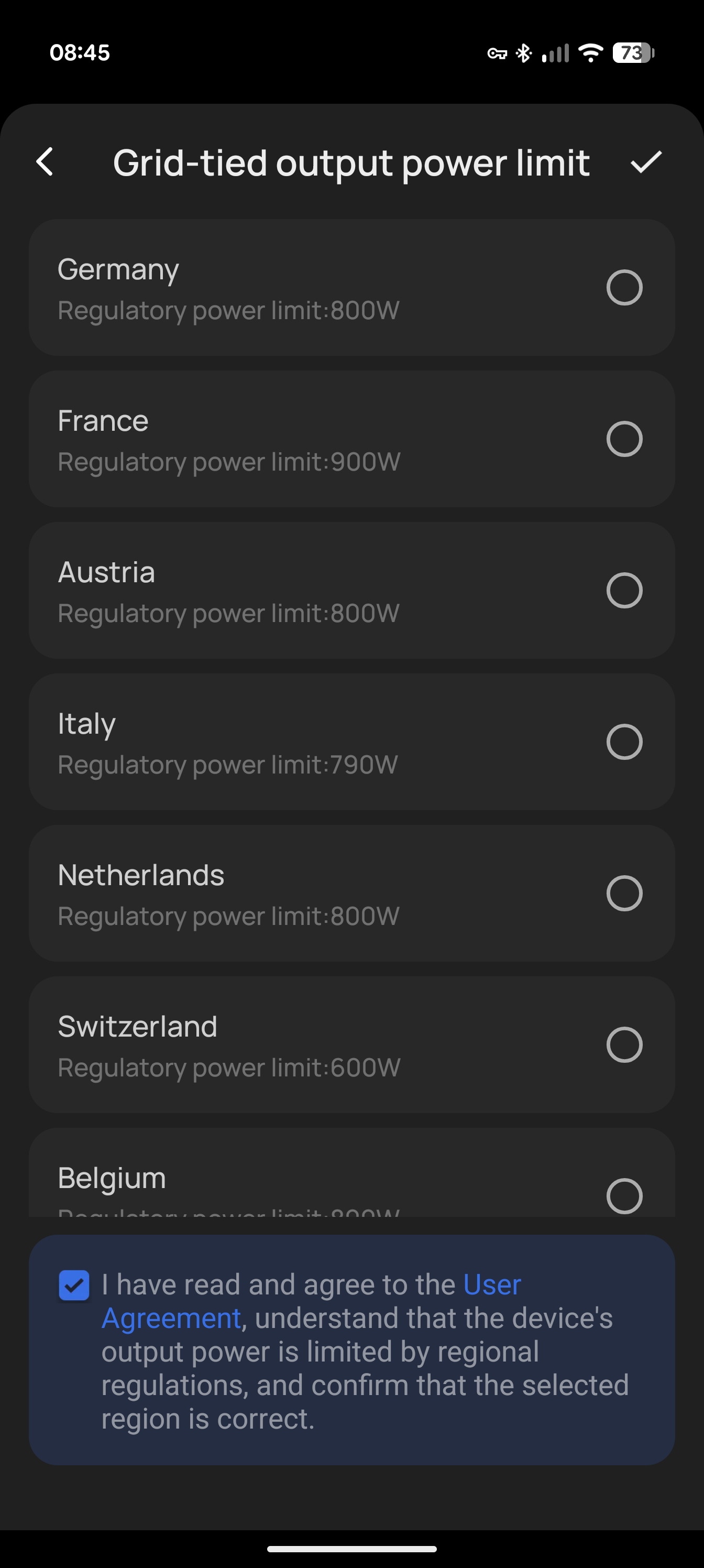
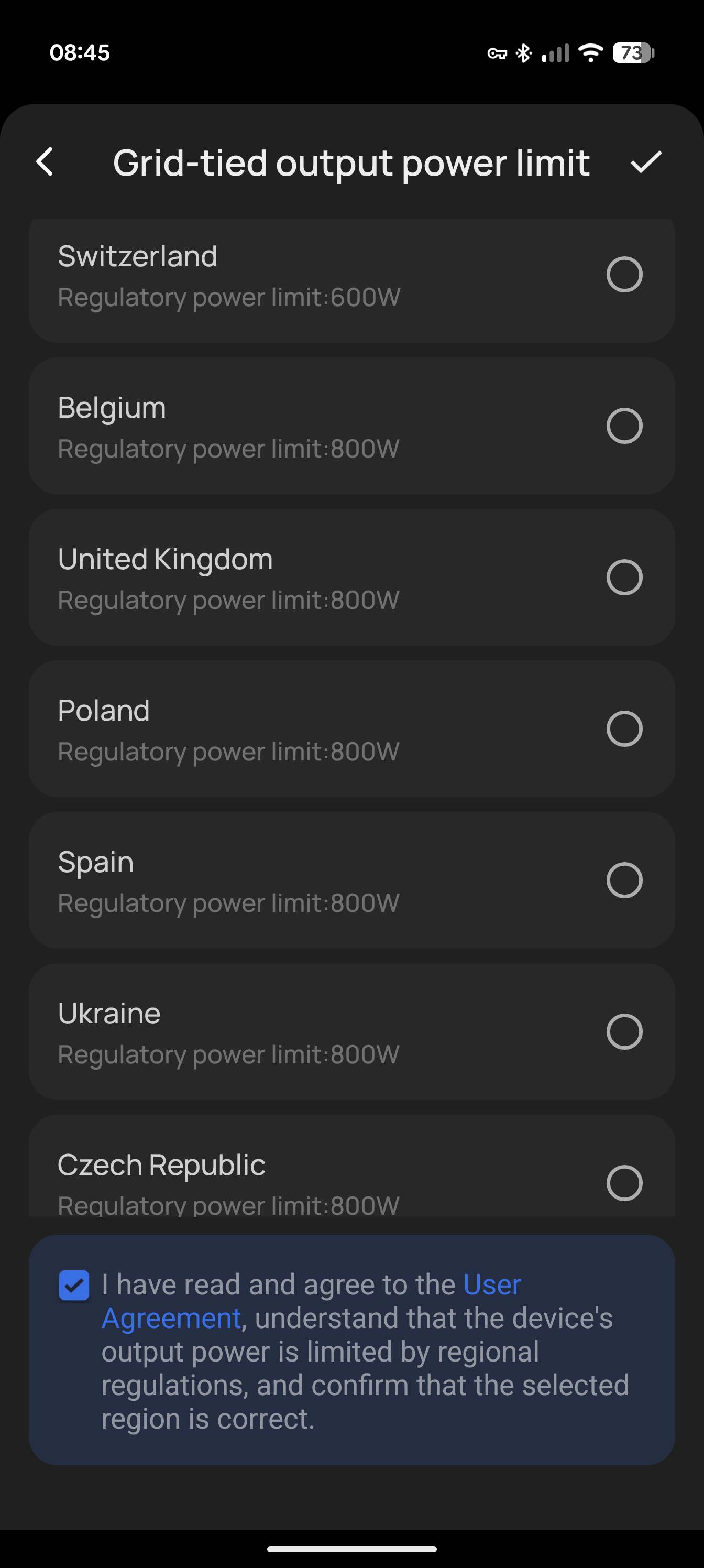
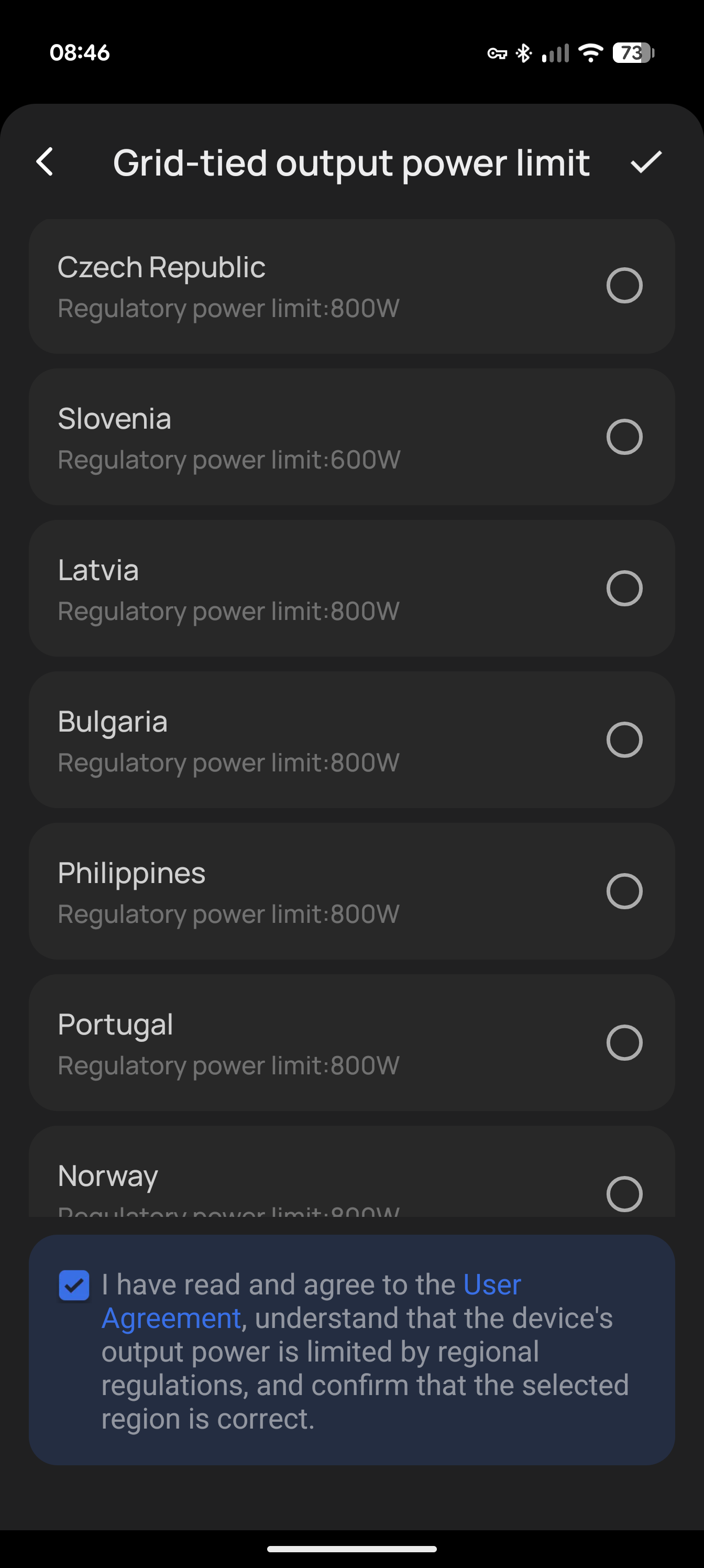
Germany, France, Austria, Italy, Netherlands, Switzerland, Belgium, UK, Poland, Spain, Ukraine, Czech Republic, Slovenia, Latvia, Bulgaria, Portugal, Norway — and no Greece.
What Greece Says#
Nothing. Literally nothing.
As of March 2026, Greece has no specific legislation for balcony solar panels. There’s no law that explicitly allows them, and no law that explicitly bans them. It’s a regulatory void.
What’s been promised:
- The Ministry of Environment and Energy is “examining” the introduction of balcony solar as part of a package with net-billing modifications
- The Association of Photovoltaic Companies (SEF) has presented a proposal to the ministry, which responded “positively in principle”
- A plan exists to create a registry at DEDDIE (the grid operator) — registration only, no licensing
- A 3-month adjustment period was planned for DEDDIE to build the platform
What’s actually happened:
- None of this has been implemented
- “Examining” has been the status for over a year
- The existing self-consumption framework has no category for plug-in systems
- Greek stores are already selling balcony solar kits — BestPrice.gr lists EcoFlow panels, SolarFox.gr sells dedicated balcony kits, fotovoltaika.gr offers plug-and-play systems, eshop.com.gr has a full balcony solar category, and Electric Power sells 1000W balcony kits. The market exists, the law doesn’t
One of the sunniest countries in Europe, and we’re behind Belgium.
My Setup — And What the Meter Actually Records#
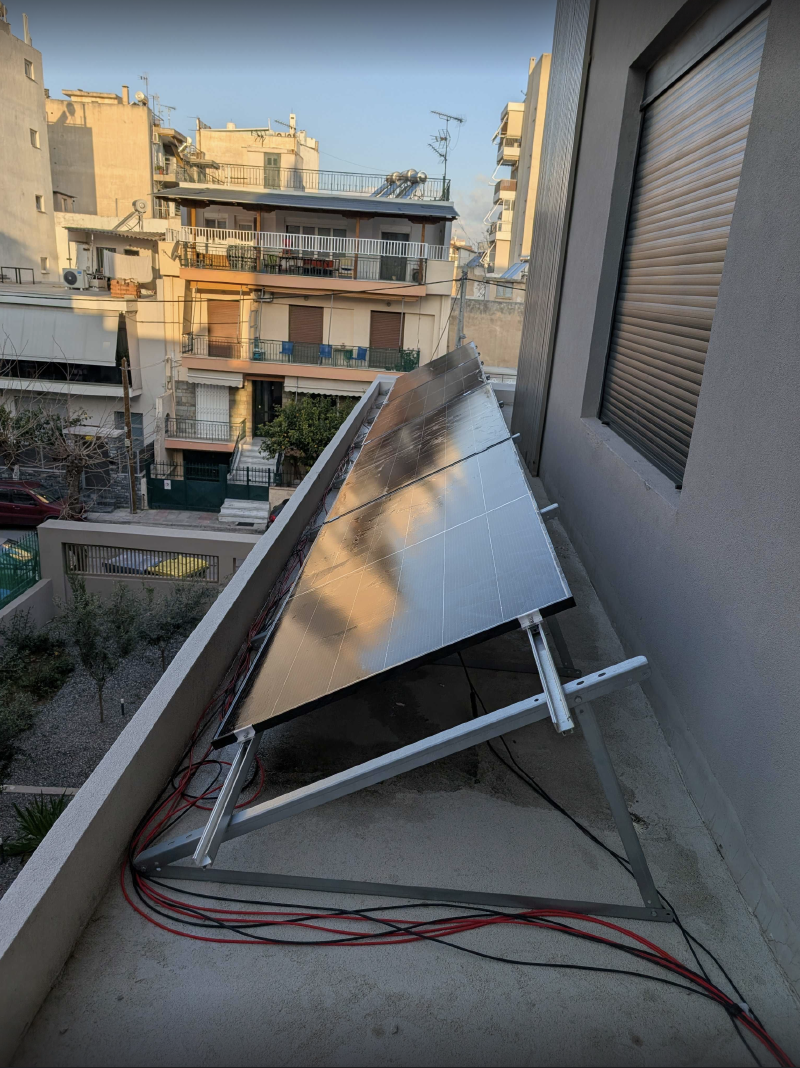
I have an EcoFlow Stream Ultra with 4 bifacial panels on my balcony, running in zero-export mode. The system never intentionally feeds electricity back to the grid — everything goes to batteries first, then to the house.
But “zero-export” isn’t mathematically perfect. Here’s why: the EcoFlow constantly monitors house consumption via a Shelly Pro 3EM energy meter and adjusts its output to match. But when a high-draw appliance suddenly stops — say a kettle that was pulling 1000W finishes boiling — there’s a brief gap. The kettle stops drawing instantly, but EcoFlow is still injecting those 1000W into the house. It takes a moment for the Shelly to read the new (lower) consumption, report it back to EcoFlow, and for EcoFlow to throttle down its output. During that brief window, some power leaks to the grid. The DEDDIE smart meter records everything.
Here’s what the meter’s export register (2.8.0) has recorded since installation:
| Date | Total Export (kWh) |
|---|---|
| 24/09/2025 | 0.00 |
| 25/09/2025 | 0.07 |
| 30/09/2025 | 0.60 |
| 01/10/2025 | 0.72 |
| 02/10/2025 | 0.73 |
| 07/10/2025 | 0.92 |
| 11/10/2025 | 1.33 |
| 20/10/2025 | 1.75 |
| 07/11/2025 | 2.54 |
| 04/12/2025 | 3.34 |
| 11/01/2026 | 4.10 |
| 08/02/2026 | 4.86 |
4.86 kWh exported in ~5 months — that’s about 1 kWh per month of leakage. For context, that’s roughly the energy to run a light bulb for 10 hours. It’s practically nothing, but the meter catches every fraction of it.
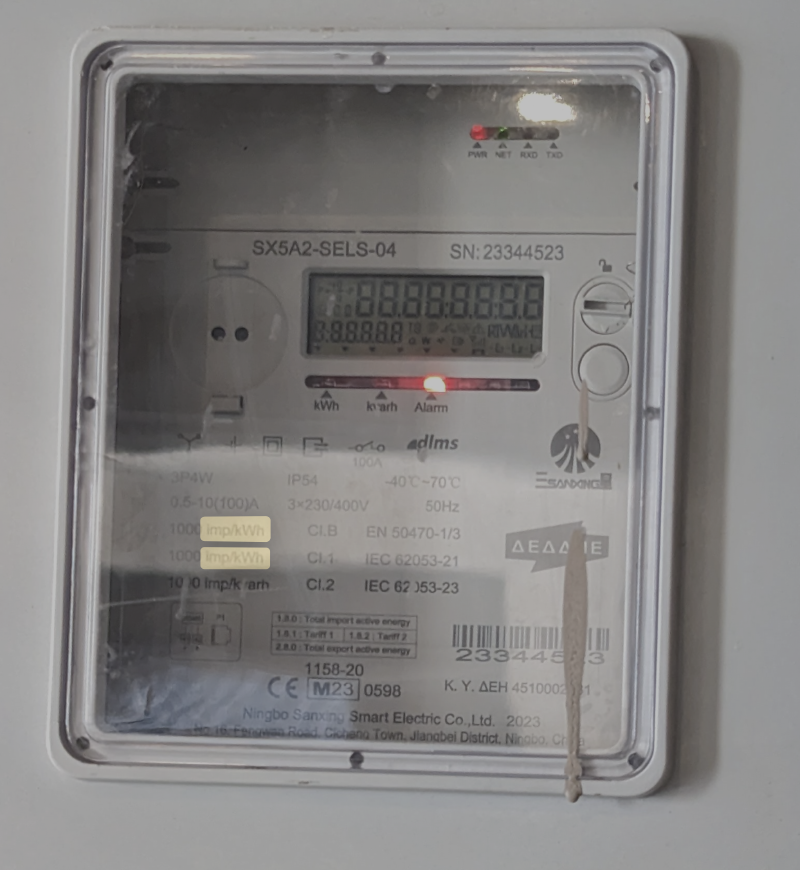
The meter is a Sanxing SX5A2-SELS-04 — a modern smart meter that records:
- 1.8.0 — Total import (what you consume from the grid)
- 1.8.1 / 1.8.2 — Import by tariff
- 2.8.0 — Total export (what goes back to the grid)
The meter records these exports in register 2.8.0 whether anyone looks or not. If DEDDIE reads the meter remotely (which smart meters support), they could see those 4.86 kWh. Whether anyone actually checks or cares about 1 kWh/month of export from what’s clearly a small domestic system — that’s another question entirely.
The Practical Reality#
From a technical standpoint:
- DEDDIE sees almost nothing — 1 kWh/month of export is noise-level
- No impact on the grid — the system is electrically invisible for all practical purposes
- No net-metering agreement needed — I’m not selling or feeding back anything meaningful
- I’m consuming my own production — batteries absorb the surplus, the house uses it, and when there’s enough sun the EV charges from the excess
- Safe during power outages — all grid-tied inverters (including EcoFlow) are required to have anti-islanding protection. When the grid goes down, the inverter stops injecting immediately. It rides the grid’s carrier signal — no grid signal, no injection. This is a hard safety requirement across the EU: electricians and utility workers repairing a power outage will never be exposed to energy being fed back from a balcony solar system. The inverter physically cannot operate without detecting a live grid.
The “risk” is not a fine or disconnection — nobody is policing balcony solar in Greece. The risk is that there’s no legal clarity, which means:
- You can’t get insurance coverage that explicitly mentions your solar system
- If there’s ever an electrical incident, you have no legal framework to point to
- Your electrician might refuse to sign off on the installation
What Needs to Happen#
What Greece needs is what every other EU country has already done:
- Define a power threshold (800W or 2kW) below which systems are plug-and-play
- Create an online registration at DEDDIE — not licensing, just registration
- Allow zero-export systems without any registration — they don’t affect the grid
- Optionally allow feed-in with a simple form for systems below the threshold
Germany did this. Austria did this. The Netherlands did this. Belgium did this last year. Bulgaria has fully legislated and approved it. It’s not complicated legislation. It’s a threshold and a registration form.
The Bottom Line#
If you’re in Greece and wondering about balcony solar: the hardware works, the savings are real, the technology is mature, and the EU is pushing it. My system has been running for 5 months with less than 5 kWh of accidental export.
The Greek legal framework will catch up eventually — the EU directive essentially forces it. Whether you wait for that, or join the thousands who already have panels on their balconies, is up to you. But with a zero-export system and a meter that barely notices you exist, it’s about as safe a grey zone as you’ll find.
Sources: