If you’re considering adding expansion batteries to an EcoFlow Stream Ultra system, this post might save you some money. I bought one, monitored it for weeks, and the data tells a clear story.
Everything below is backed by real measurements from Home Assistant with Prometheus at 1-minute resolution. The raw data is available for download at the bottom of this post — verify everything yourself.
My Setup#
| Component | Role |
|---|---|
| EcoFlow Stream Ultra | Main unit — 4 MPPT solar inputs, 1200W inverter, 1.92 kWh LFP battery |
| EcoFlow Stream AC Pro | Expansion battery — 1.92 kWh LFP, built-in inverter, no solar inputs |
| EcoFlow Parallel Cable | Proprietary AC cable connecting Ultra to AC Pro |
| 4× 520W bifacial panels | ~2 kWp total, connected to the Ultra’s 4 MPPTs |
| Shelly Pro 3EM | Grid meter for zero-export control |
The AC Pro has no solar inputs of its own. It connects to the Ultra via a proprietary AC parallel cable. The only path for solar energy to reach the AC Pro is: panels → Ultra’s DC bus → Ultra’s 1200W inverter → AC cable → AC Pro’s inverter → AC Pro’s battery. Two conversions (DC→AC→DC), through a shared 1200W inverter.
I purchased the AC Pro (€849) to double my storage from 1.92 kWh to 3.84 kWh, based on EcoFlow’s marketing of seamless expansion.
What EcoFlow Markets#
Their product page says:
“Expandable capacity from 3.84 to 23kWh”
“Up to 6 devices per system”
“Surplus solar energy automatically transfers between batteries”
To be precise about terminology: the storage capacity claim (kWh) is technically correct — the batteries exist and hold charge. The issue is with the energy transfer claim. “Surplus solar energy automatically transfers between batteries” describes power flow (kW), and under normal household conditions, it doesn’t happen. Here’s why.
The Data: April 7, 2026#
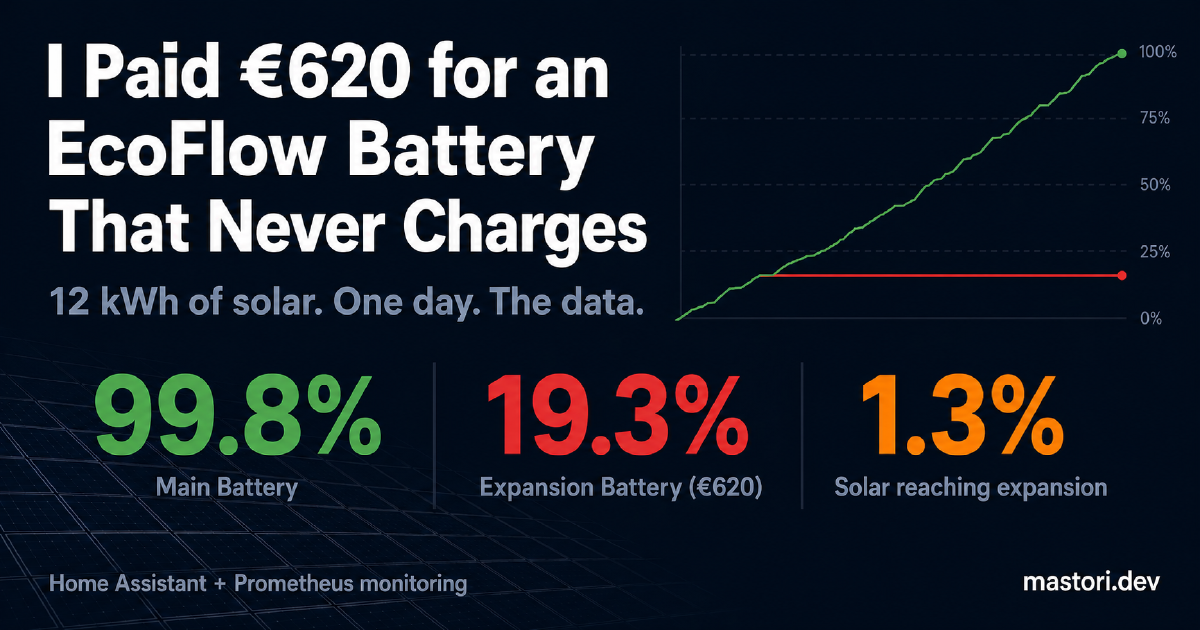
Clear sky over Athens. 12 kWh of solar energy produced. Both batteries started the day at ~10%.
The main battery charged to 99.8%. The expansion battery reached 19.3%. This pattern is consistent across weeks of monitoring — it’s not a one-off.
Why This Happens#
The Stream Ultra has a 1200W inverter. This inverter serves two purposes: powering your home, and transferring energy to expansion batteries (which connect via AC coupling). Both functions share the same 1200W.
Under any normal household load, the inverter is fully consumed powering the home. Nothing remains for the expansion battery.
Think of it as two water tanks sharing one pipe that’s already watering your garden. The second tank stays empty — not because there’s no water, but because the pipe is busy.
The panels produced nearly 2000W at peak. The inverter passed through 1200W. The remaining ~800W had nowhere to go — the expansion battery couldn’t receive it through the saturated inverter.
Where the Energy Goes#
The inverter’s 1200W capacity is consumed powering the home. The main battery absorbs whatever DC surplus remains before the inverter. The expansion battery received 0.16 kWh out of 12 kWh produced — 1.3% of available solar energy.
Solar Curtailment#
When the main battery reaches 100% and the inverter is fully allocated, the system curtails PV production. The expansion battery is at 18% and has capacity available, but the AC-coupled architecture provides no path for energy to reach it. The panels reduce output because the system has no buffer left — despite 1.92 kWh of empty storage sitting idle.
Scaling: What “Expandable to 6 Batteries” Actually Means#
The storage capacity scales as advertised — add batteries, get more kWh. But the charging rate from solar doesn’t scale at all. Every expansion battery shares the same 1200W inverter for solar charging:
| Setup | Cost | Total Storage | Solar Charging Bottleneck | Effective Solar Charging |
|---|---|---|---|---|
| 1 Ultra | ~€1,480 | 1.92 kWh | 1200W (dedicated) | Full |
| 1 Ultra + 1 AC Pro | ~€2,329 | 3.84 kWh | 1200W (shared with home) | Main battery only under load |
| 1 Ultra + 2 AC Pro | ~€3,178 | 5.76 kWh | 1200W (shared with home) | Main battery only under load |
| 1 Ultra + 5 AC Pro | ~€5,725 | 11.52 kWh | 1200W (shared with home) | Main battery only under load |
With 6 batteries under normal household load, only the main battery charges from solar during the day. The other 5 batteries have the capacity but no path to receive solar energy.
For the Stream Ultra X (“expandable to 23 kWh”): that’s 6 units at 3.84 kWh each, all dependent on one 1200W inverter. Even with zero home consumption, charging 5 empty units through that inverter takes over 18 hours — longer than the longest summer solar day in Greece.
The capacity claim (kWh) is correct. The practical ability to charge that capacity from solar under real-world conditions is the problem.
EcoFlow’s Response#
I submitted a detailed technical report to EcoFlow EU Support with monitoring data, screenshots, and specific sensor readings. Their R&D team confirmed the limitation:
“The inverter limit of the Stream Ultra itself is only 1200W. The transfer of PV power between different devices must go through the inverter for conversion. The remaining solar energy can only be used to charge the Stream Ultra directly.”
Their suggested workaround:
“We recommend that when charging is required, you first remove or reduce the load.”
I requested a reasonable resolution — an exchange for a Stream Ultra X (same total capacity in a single unit, no AC-coupling bottleneck). The case has been escalated and is ongoing.
The Architecture Problem: AC vs DC Coupling#
This isn’t unique to EcoFlow — it’s an architecture choice. The Stream series uses AC-coupled expansion: batteries connect via AC, requiring double conversion (DC→AC→DC) through a shared inverter. This creates the bottleneck.
The alternative is DC-coupled expansion, where batteries connect directly to the solar charge controller. No inverter bottleneck, no shared bus. All batteries charge equally from solar.
Products that use DC-coupled expansion include Anker SOLIX (Solarbank 2), Zendure (SolarFlow Hub), and Marstek (Jupiter series). I haven’t tested them — do your own research. The key question to ask any vendor: “When I add a second battery, does it charge through the inverter or directly from DC?”
If You Own This System#
If you have Home Assistant or any monitoring, compare both battery SoC values during a sunny day with normal household load. If you see the same divergence, it’s the same issue.
EU consumers have a 2-year legal guarantee under Directive 2019/771. Marketing claims like “surplus solar energy automatically transfers between batteries” form part of the product’s conformity requirements. If the product doesn’t deliver on those claims, consumers are entitled to remedy.
Alternatives: What DC-Coupled Expansion Looks Like#
The 1200W bottleneck exists because expansion batteries are connected via AC coupling. Several competing balcony / plug-in solar systems use DC coupling instead — the expansion battery connects directly to the solar charge controller, bypassing the inverter. This eliminates the shared-inverter bottleneck.
I haven’t personally tested these. I’m listing them because they represent a different architecture choice. Do your own research before buying anything — specifications and firmware change, and every household’s load profile is different.
| System | Architecture | Solar input per unit | Expansion limit | Notes |
|---|---|---|---|---|
| EcoFlow Stream Ultra + AC Pro | AC-coupled expansion | 2000W (Ultra only) | 6 units | Shared 1200W inverter — expansion can’t charge under household load > 1200W |
| Anker SOLIX Solarbank 2 | DC-coupled expansion | Up to 2400W | Up to 3 expansion batteries | Each expansion battery receives DC directly from MPPT |
| Zendure SolarFlow Hub 2000 | DC-coupled expansion | Up to 2000W | Up to 4 AB2000 batteries | MPPT distributes directly to expansion batteries |
| Marstek Jupiter C | DC-coupled (single-unit) | 2500W | Not modular | Single unit, larger capacity, no expansion bottleneck |
The question to ask any balcony-solar vendor before you buy:
“When I add a second battery, does it charge through the inverter or directly from DC?”
If the answer is “through the inverter” — you have the same architecture problem I’m describing here, regardless of brand.
FAQ#
“Can’t you just reduce the load while the batteries charge?” EcoFlow’s own support team suggested this. It reverses the purpose of owning the system. I bought 3.84 kWh of storage to use solar while I live normally — not to power down my home so the batteries can charge. The marketing says “Automatically transfers”, not “Transfers if you turn things off”.
“Why not just charge it from the grid at night?” The product is marketed as a solar storage system, not a grid-charged UPS. Charging from the grid at €0.15/kWh and discharging to offset daytime solar you paid for is a net loss. The entire premise of the expansion battery is to capture more solar — not to shift grid consumption.
“Isn’t this just how AC coupling works? Why blame EcoFlow?” AC coupling is a legitimate architecture choice with trade-offs. The problem isn’t that EcoFlow uses it. The problem is that EcoFlow markets the system as if the trade-off doesn’t exist: “Surplus solar energy automatically transfers between batteries” is stated as fact, without the critical qualifier “only when household load is below 1200W”. Competitors using DC coupling (see table above) don’t have this problem.
“Isn’t 1200W a lot? Most homes don’t draw that much.” A single induction hob, electric kettle, washing machine, or EV charger exceeds 1200W. An oven preheats at ~2000W. A hair dryer is 1800W. “Below 1200W continuous” is an atypical load for a European household during the day. The condition under which expansion charging actually works is the exception, not the rule.
“What if I just need more daytime power and don’t care about expansion charging?” Fair — if you only need the additional battery to discharge into your home at night (grid-charged), the AC Pro works. But that’s not what the marketing sells. The product page says “Zero Solar Energy Waste” and “Expandable capacity from 3.84 to 23 kWh” — both claims implicitly promise the expansion capacity will be filled from solar. It won’t.
“Why not just return it?” I’m trying. That’s exactly what the ongoing EU consumer-rights case is about.
“Is this a defective unit?” No. EcoFlow’s R&D team confirmed this is how the system is designed to work. Every Stream Ultra + AC Pro pairing has the same 1200W inverter in the Ultra, and the same AC-coupled architecture. The behavior is reproducible on every unit of this product.
“Firmware update will fix it?”
Firmware can change which battery charges first (workaround to reduce waste — see the technical post), but cannot remove the 1200W inverter bottleneck. That’s a hardware constraint. 2000W solar − 1200W inverter = 800W that physically cannot pass through the cable to the expansion battery under load.
Want the full technical deep-dive with architecture diagrams, BMS chip analysis, and firmware workaround proposals? Read: The Parallel Battery Imbalance Nobody Warns You About
All raw data (Prometheus, 1-minute resolution) is available for download — verify everything yourself: april-2026-data.json
Prefer a full-page interactive view? Open the standalone data dashboard

💬 Comments
Questions, corrections, or your own setup? Sign in with GitHub and leave a note.